The story
Euro 7 is moving towards Britain’s new-car rulebook, but the dates need careful reading. In its 27 October response, the Department for Transport set out its intended approach for Great Britain. This is about approving and registering new vehicles, rather than a demand to replace the JAECOO already sitting on your drive.
The club view
Buy the car and specification that meet your needs, with the registration position confirmed in writing. A future standard is useful context; it is not a reason to panic-buy, assume a price rise or discard a perfectly serviceable vehicle. We will judge the final rules by the legislation and the exact car, not a dramatic headline.
What has the government actually decided?
The Department for Transport’s final consultation response says it will proceed with Euro 7 in Great Britain. For ordinary mass-production new cars and vans, it retains an intended implementation date of 29 November 2027 for new registrations.
Crucially, it drops the separate mandatory Great Britain deadline for newly approved light-duty vehicle types that had appeared in the earlier proposal. A “new type” is a manufacturer’s approval category; a “new registration” concerns an individual vehicle joining the register. Treating those as the same event is how a useful date becomes a confusing headline.
Is this already a law in force?
Reviewed on 3 November 2026, the government response says DfT will lay a statutory instrument to implement the Great Britain requirements. Our source check did not establish the final implementing instrument or its commencement. We therefore describe the government’s intended timetable, rather than claim a new requirement is already in force.
The response also explains that acceptance of EU Euro 7 approvals under the Great Britain approval scheme depends on the legislation coming into force. An announcement, an approval route and a vehicle’s own certification are different pieces of the puzzle.
This article covers the main passenger-car position. The response includes separate treatment for small-volume manufacturers and limited-series approval schemes; it should not be reduced to a claim that every vehicle of every category faces one deadline.
Does my current JAECOO have to become Euro 7?
The policy described is for new-vehicle approval and registration. It does not announce a retrospective Euro 7 conversion programme for cars already registered. There is no new JAECOO retrofit, replacement or scrappage instruction established by this response.
Keep looking after the vehicle you actually own. Follow its servicing requirements and deal with safety campaigns through the normal channels. A future emissions standard does not replace the paperwork that applies to your present car.
Our warranty and service-record guide and maintenance guide cover those ownership jobs. Your diary does not need a mysterious extra “become Euro 7” appointment.
Why should an electric-car buyer care about emissions rules?
An electric car has no tailpipe, but a vehicle standard can cover more than exhaust emissions. The Euro 7 policy programme also concerns brakes, tyres and battery durability. That gives E5 buyers a reason to follow the final requirements alongside buyers of petrol and hybrid cars.
It does not give today’s E5 a new battery warranty, promise a software update or establish a new charging speed. A manufacturer warranty is a contract with its own conditions; a regulatory durability requirement is a different matter. Do not swap one set of promises for the other.
For the car’s reviewed UK features, use the JAECOO E5 model guide. Nothing in this policy report establishes that a particular current JAECOO derivative has Euro 7 approval.
Great Britain and Northern Ireland: keep the routes separate
The 27 October response concerns Great Britain: England, Scotland and Wales. Northern Ireland’s vehicle type-approval position follows a different framework. The Northern Ireland Assembly’s 18 May briefing explains its alignment with EU type-approval rules under the Windsor Framework.
Do not apply a Great Britain headline automatically to a vehicle being supplied or registered in Northern Ireland. Ask the retailer to confirm the correct approval and registration route for the exact car and intended location. This is particularly useful when comparing stock advertised in different parts of the UK.
We are not using an older consultation table or a general European deadline as proof that a particular JAECOO can, or cannot, be registered in Northern Ireland.
What should a buyer ask before placing an order?
- Which exact vehicle? Record the model, powertrain, trim and specification on the quote. A model name alone is not an approval record.
- Where will it be registered? Make the intended Great Britain or Northern Ireland destination clear.
- When is registration expected? Ask how any applicable rule change could affect an order scheduled close to a transition date.
- What evidence supports the answer? Ask for confirmation of the applicable approval/emissions standard and the vehicle documentation, rather than rely on a verbal “it will be fine”.
- What happens if delivery slips? Read the order’s cancellation, delay and specification-change terms before paying a deposit.
That is sensible order checking, not a prediction that a JAECOO order will have a problem. Our handover checklist helps carry the written specification through to collection.
Does Euro 7 mean higher prices, different road tax or a driving ban?
This response does not publish new JAECOO prices. It gives us no defensible amount to add to a J5, E5, J7 or J8 quote. Claims about future manufacturing costs are not the same as a confirmed retail price change.
It is also not an announcement of a new tax bill for your car or a change to a local clean-air-zone charge. Those questions need their own current rules and vehicle checks. We keep the Budget’s fuel, charging and tax measures separate from this approval-policy story.
Compare the complete cost and suitability of the JAECOO models available to you. Waiting for clearer information can be sensible; assuming an unannounced surcharge is not a buying strategy.
What will make the next update worthwhile?
The next meaningful evidence is the implementing legislation, its actual commencement and any relevant transition arrangements, followed by clear manufacturer information for specific vehicles. If those change the practical buying position, this article should be updated while keeping its original publication date.
Until then, the useful distinction is straightforward: the government has chosen a direction for future new-car standards; an owner still needs the facts for their own car. That leaves room for informed questions without turning a policy calendar into a panic button.
Research sources and methodology
Checked 3 Nov 2026. Reviewed 3 November 2026. Full DfT response and its government decision/next-steps sections read; NI Assembly briefing used for territorial context. A focused search did not establish a final GB Euro 7 implementing instrument or commencement, so no claim of enacted implementation is made. No current JAECOO approval certificate, retrofit obligation, price change or new warranty entitlement is inferred. Practical buyer checklist and Club view are original editorial analysis. Real overseas cover photo is illustrative model context only.
- Department for Transport: final Euro 7 consultation response — Updated 27 October 2026; full response directly reviewed 3 November. Government response and next steps take precedence over the earlier proposal. Intended GB timetable, scope and future statutory instrument kept distinct.
- Northern Ireland Assembly: vehicle type-approval briefing — Research and Information Service paper 41/26, 18 May 2026. Used for the NI/EU approval-framework distinction, not as a current JAECOO registration decision or proof of final GB implementation.
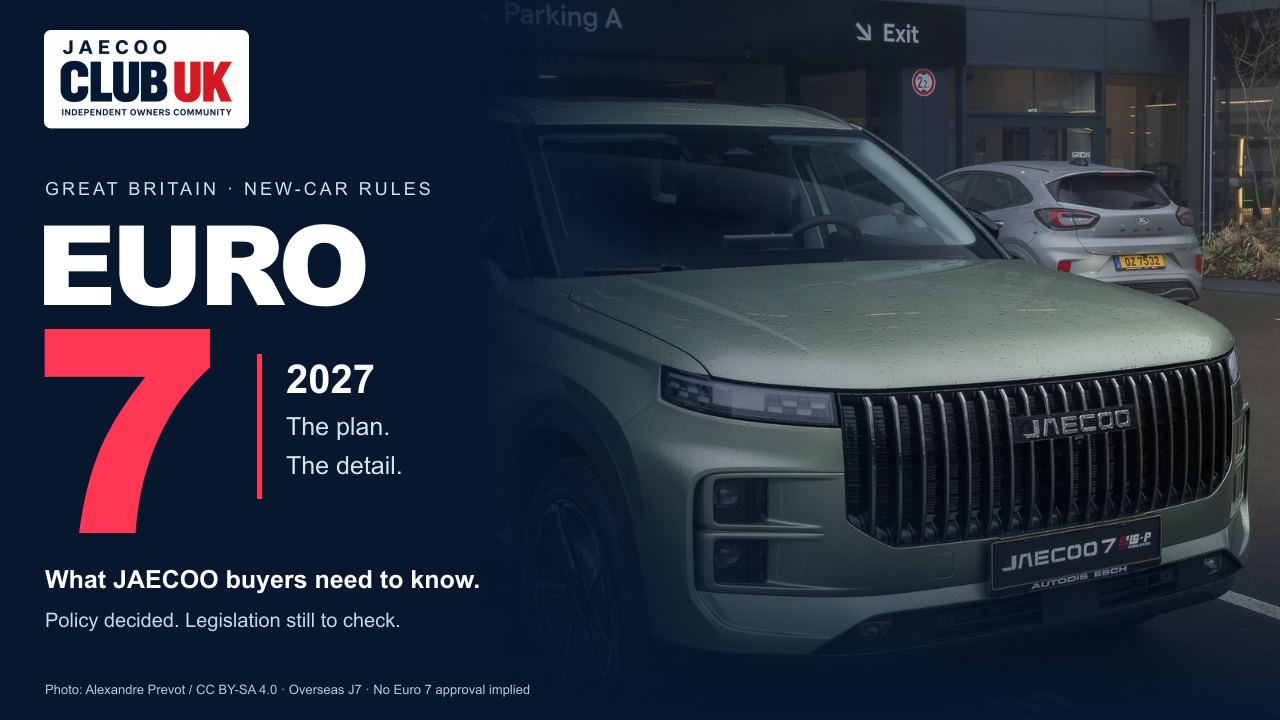
- Cover photograph: Alexandre Prevot, Wikimedia Commons — JAECOO 7 SHS-P, Luxembourg, 24 January 2026. CC BY-SA 4.0 adaptation permission rechecked 3 November; original photograph used, cropped and resized, with no generated vehicle details.
- Photograph and cover adaptation: CC BY-SA 4.0 — Attribution and share-alike apply to the photograph and branded adaptation; trademark rights unaffected.
SOURCES & DISCLOSURE
Go to the original.
Department for Transport — read the source ↗Independent editorial roundup by JAECOO Club UK. Source checked 3 Nov 2026. Reported claims and review opinions remain attributed to their original source.