The story
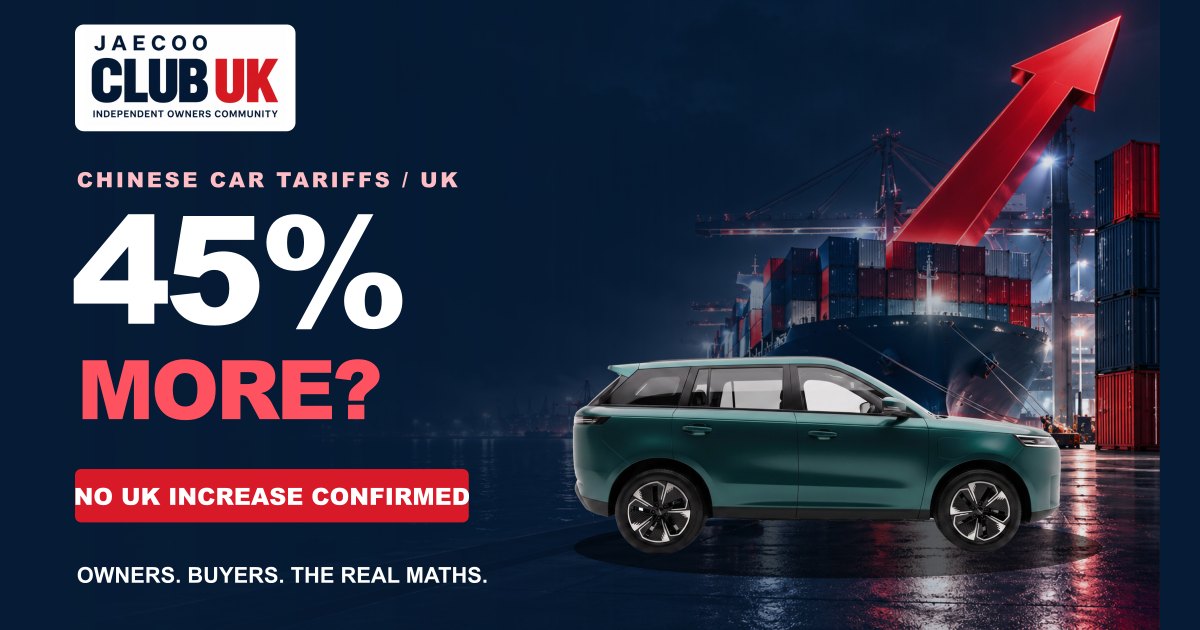
The 45% headline is not a confirmed increase in UK showroom prices. Our 27 October update adds the 20 October parliamentary evidence and clearly attributed later reporting. The vehicle prices and worked examples retain their 8 October snapshot: they are conditional calculations, not new JAECOO quotations.
The club view
What might you pay, which car could be covered, and what if you already own one? The answer changes between an electric E5 and petrol or hybrid JAECOOs. This explainer separates sourced facts from our conditional analysis, with transparent arithmetic rather than a frightening percentage pasted onto every windscreen.
Latest UK policy evidence: decision remains under review
At the 20 October committee hearing, questions 63–66, Jonathan Reynolds said the UK position was unchanged and kept under close review. He said UK interests would determine any trade-defence decision. That is a dated ministerial statement, not an enacted tariff.
Reynolds distinguished press reports about Franco-German proposals from a negotiation with Britain. He also explained that assembling Chinese components in Britain would not, by itself, qualify a car for preferential UK–EU treatment under the trade agreement’s rules of origin. Possible Sunderland production therefore does not establish a tariff exemption.
Separately, Autocar reported on 23 October that China warned of countermeasures if Britain restricted Chinese-car imports. We reviewed the accessible opening of that report; its remaining text requires a subscription. This is attributed reporting, not independent verification of a Chinese policy document.
The earlier 14 October minister interview and 16 October policy report remain part of the chronology. Read each statement against its own date, rather than treating it as a guarantee of future policy.
For a buyer, the practical questions are unchanged: is the quoted total fixed, which changes can be passed on, and what happens if delivery is delayed? Request the answers in writing. Neither a political warning nor a deposit supplies the missing legal scope, rate, start date or transition rules. Use our E5 model guide and current offer breakdowns for vehicle and purchase context; the worked prices below remain the dated 8 October scenarios.
The answer before the alarm bells
The 20 October ministerial evidence does not announce a new UK Chinese-car duty or commencement date. Our 27 October check did not locate a Chinese passenger-car case in the displayed TRA active-investigations register; that limited check cannot establish every legal measure or future policy decision. Normal import duty and the EU’s measures remain separate questions.
Our worked prices below are still the labelled 8 October snapshot.
Read the latest policy update →- 45.3% is the EU maximum combined duty benchmark: 10% ordinary duty plus up to 35.3% additional countervailing duty. It is not an automatic 45% addition to a UK retail price.
- The electric E5 is the clearest JAECOO exposure under an EU-style battery-electric measure. Petrol and hybrid JAECOOs are different cases.
- Already own one? The reported proposal does not establish a retrospective bill for a car already bought and in UK circulation.
- Ordering now? Get written price protection and cancellation terms. A deposit is not a magic tariff shield.
What has actually been reported?
Reuters reported on 4 October that The Times said Britain was considering tariffs on Chinese EV imports, connected to subsidised imports and proposed EU Made in Europe rules. Reuters said it could not immediately verify the newspaper’s report; the government response said no tariffs had been imposed on Chinese EVs. That distinction matters more than the dramatic headline. Reuters’ report, reproduced by Euronext.
Auto Express covered the story on 5 October and carried the government response. Its 18 September interview had described a position against higher tariffs. The subsequent reporting indicates a live debate rather than a settled customer bill. 5 October coverage; 18 September interview.
A parliamentary answer on 2 July said the government was assessing options, including tariffs, and that the Trade Remedies Authority had not then initiated an EV investigation. That is a dated statement, not proof of every subsequent day’s position. The original review checked the TRA public file and official notices without locating a new enacted car measure. The register was checked again for the 17 October update; that limited check does not establish every possible future government action. July answer; TRA public file.
The missing details are decisive: the legal instrument, vehicles covered, exporter rates, start date, treatment of goods already imported and transition arrangements. Until these exist, nobody can responsibly offer a tariff countdown or a guaranteed new JAECOO price.
Where does the 45% figure come from?
The European Commission’s October 2024 decision imposed additional countervailing duties on new battery-electric vehicles originating in China. Its published additional rates included BYD 17%, Geely 18.8%, SAIC 35.3%, other cooperating producers 20.7%, and Tesla 7.8% following individual examination. The maximum headline combines 10% ordinary duty and 35.3% additional duty: 45.3% altogether. European Commission’s announcement.
Those are not a blanket JAECOO rate. An EU decision does not itself change UK law, and we have not established a future UK rate for Chery or JAECOO. The exporting company, origin, classification and current legal treatment matter; the badge is not the customs paperwork.
The legal scope concerns battery-electric vehicles, including certain electric-only drive arrangements with an auxiliary combustion range extender. Merely spotting an engine is therefore not a universal classification test. JAECOO’s UK pages separately identify SHS-P models as plug-in hybrids. EU regulation and consolidated text.
EU arrangements can evolve too: the Commission issued price-undertaking guidance in January 2026. Such offers concern agreed export pricing as an alternative approach to the subsidy issue, not a UK consumer discount. Check current exporter-specific treatment rather than assuming the 2024 maximum is universal forever. January 2026 announcement.
Which JAECOO models could be affected?
If the UK copied the EU’s battery-electric scope, the E5 would be the obvious model to examine. This is a conditional scope assessment, not confirmation of a UK charge.
| Model / powertrain | EU-style BEV scope | What to check |
|---|---|---|
| E5 electric | Potentially within scope | Origin, exporter and final UK rules |
| J5 petrol | Not a BEV | A broader measure needs its own scope |
| J7 petrol | Not a BEV | Do not apply an EV headline automatically |
| J7 SHS-H full hybrid | Not a BEV | Not externally charged |
| J7 SHS-P plug-in hybrid | Not a BEV | Plug-in hybrid is not battery-electric |
| J8 SHS-P plug-in hybrid | Not a BEV | Broader UK rules could change the outcome |
The common mix-up is J5 versus E5: one is petrol, the other electric. SHS-H and SHS-P are also different. Manufacturer descriptions: J5/E5, J7 range and J8.
A future UK measure could have different coverage. We cannot promise hybrids immunity; we can say an EU-style BEV measure would not automatically cover every Chinese petrol or plug-in hybrid SUV.
Manufacturing origin also matters more than nationality of the badge. China-origin vehicles from Western brands can be relevant. Moving assembly elsewhere is not automatically an exemption: origin and any anti-circumvention rules would still need checking.
A tariff is not the same as a showroom price rise
Duty is based on customs value, not the dealer’s windscreen price. HMRC’s transaction-value approach includes adjustments such as transport and insurance to the UK border. Customs value is neither published basic retail price nor VAT-inclusive on-the-road price. HMRC valuation guidance.
If existing duty of 10% became 45.3% in total, the additional duty would be 35.3 percentage points of customs value. It would not be another 45.3% on top. Multiplying today’s OTR price by 1.453 does not produce a future dealer quote.
HMRC includes duty in the import-VAT base. Recoverable import VAT is not automatically a permanent extra cost for a VAT-registered importer. Our examples instead add 20% output VAT to a duty-cost increase passed into the pre-VAT sale price, holding other costs and margins unchanged. We do not count import VAT and retail VAT twice. HMRC import-VAT guidance; VAT rates.
Manufacturers could absorb costs, reduce incentives, alter equipment or change sourcing. Dealers could change discounts; exchange rates and finance support can move independently. The buyer’s bill depends on these choices. The tariff is an ingredient in the price, not the whole recipe.
Worked example: what could happen to an E5 price?
Illustration only: assume £15,000 customs value. We do not know JAECOO’s actual customs values. Compare additional duties of 20.7 and 35.3 percentage points above the existing 10% baseline, keeping other costs constant. These are EU benchmark scenarios, not approved or proposed UK JAECOO rates.
| Additional duty scenario | Extra duty | Half passed through, incl. VAT | All passed through, incl. VAT |
|---|---|---|---|
| +20.7 percentage points | £3,105 | £1,863 | £3,726 |
| +35.3 percentage points | £5,295 | £3,177 | £6,354 |

Formula: extra duty = customs value × additional duty rate. Consumer increase = extra duty × pass-through proportion × 1.20. Zero pass-through adds £0 to the sticker price but leaves the supplier carrying the extra cost. Half pass-through is not a prediction.
Starting from E5 Pure’s checked £27,505 official OTR, adding £3,726 gives £31,231; adding £6,354 gives £33,859. The latter is about a 23.1% retail increase in this example, despite the 45.3% combined-duty benchmark. Different customs values and pricing decisions change the result.
For E5 Luxury at £30,505, the same assumed absolute increases give £34,231 or £36,859. We use identical customs values only to make the arithmetic comparable, not because the trims necessarily cost the importer the same amount. These are not forecasts or dealer quotations.
Current JAECOO prices: starting points, not forecasts
| UK specification | Official OTR | If EU BEV scope were copied |
|---|---|---|
| J5 petrol Pure | £24,555 | Not a BEV |
| J5 petrol Luxury | £28,050 | Not a BEV |
| E5 electric Pure | £27,505 | Potential BEV exposure |
| E5 electric Luxury | £30,505 | Potential BEV exposure |
| J7 petrol Deluxe FWD | £30,165 | Not a BEV |
| J7 petrol Luxury AWD | £34,025 | Not a BEV |
| J7 SHS-H Pure | £29,210 | Not a BEV |
| J7 SHS-H Deluxe | £32,810 | Not a BEV |
| J7 SHS-P Luxury | £35,170 | Not a BEV |
| J7 SHS-P Black Luxury | £36,505 | Not a BEV |
| J8 SHS-P Luxury | £45,500 | Not a BEV |
| J8 SHS-P Executive | £47,500 | Not a BEV |
Sources: J5/E5 price table, J7 price table, J8 price table. Published starting prices exclude optional extras and personalised discounts. They are not guaranteed quotes. Compare live reviewed offers in our prices and offers section.
For a broader-policy budgeting exercise, a hypothetical 10% retail increase on J7 SHS-P Luxury adds £3,517, giving £38,687. On J8 Luxury it adds £4,550, giving £50,050. These are simple retail sensitivity calculations, not tariff calculations or evidence those hybrids will be covered. They show what a genuinely broader measure could mean for a household.
JAECOO’s homepage also advertises a £3,000 E5 EV Grant, subject to its own terms. That is a manufacturer promotion, not the assumed tariff calculation and not a guarantee of future support. We have not deducted it from the price table. Check eligibility and the actual written quote. JAECOO UK promotion.
Monthly payments: PCP does not follow a simple percentage
A higher cash price could mean a larger deposit, higher monthly payments, a different final payment or reduced manufacturer support. PCP depends on the amount financed, APR, term and guaranteed future value. Leasing also depends on expected residual value and funding costs. A 20% cash-price rise is not automatically a 20% payment rise.
As a deliberately simple check, spreading £3,726 over 48 equal payments without interest, fees or a balloon adds £77.63 a month, rounded to the nearest penny. Spreading £6,354 adds £132.38. This is not a PCP or lease offer; it shows why even partial pass-through matters.
Compare matching specifications and terms, including cash price, customer deposit, contributions, APR, mileage, final payment and total payable. A cheerful monthly figure with a bigger deposit behind it is still your money. Our offer comparison separates retail prices from monthly examples.
Existing owners: no automatic bill or guaranteed windfall
For a car already bought and in ordinary UK circulation, the reported proposal does not establish a new personal import bill. A vehicle-import duty is not itself a new annual ownership tax. We found no published proposal to charge existing JAECOO owners retrospectively; actual future legislation would need checking.
Dearer new cars could support demand for used alternatives, but that is not a valuation guarantee. Buyers still consider condition, mileage, reliability, warranty, finance costs and support. Reduced new-car discounts might help used prices; weak demand or uncertainty could work the other way.
A better trade-in price is not automatically a win if the replacement also costs more. Suppose your trade-in improves by £2,000 but the next car costs £4,000 more: the changeover becomes £2,000 dearer. These are hypothetical figures, not JAECOO depreciation estimates.
Keep the car in good condition, retain records and track genuinely comparable used listings over time. Asking prices are not completed sale prices. For a car you intend to keep, an imagined valuation uplift is not cash in your pocket. See our service and warranty records guide.
What about parts, repairs, insurance and warranties?
A complete-vehicle duty does not automatically put the same rate on replacement parts, batteries or workshop invoices. Products have separate classifications and rules. Wider trade disruption could affect cost or supply, but we have not identified a JAECOO parts-price increase caused by this proposal.
Insurance could respond to repair costs and replacement values, among many other factors. We cannot quantify that from a newspaper report. Get a real quote rather than applying the tariff percentage to last year’s premium.
The proposal is not itself a cancellation of existing warranties or evidence that JAECOO will leave the UK. Coverage depends on the vehicle’s terms and responsible businesses. Sensible support questions are useful; an invented brand-exit warning is not.
If your car is being repaired, keep that case separate. Ask for written progress and confirmed parts availability. A possible future duty is neither a diagnosis nor an established reason for today’s delay. Our Fault Tracker and owner diaries cover ownership evidence separately.
Buying now: should you rush to beat a tariff?
We would not buy solely because an unconfirmed headline creates urgency. Buy because the specification, test drive, overall cost and local support suit you. No verified UK implementation deadline was found in the material checked. A claim that you must order today needs evidence.
The possible benefit of buying now is an attractive, genuinely protected deal on a car you already want. Stock released into UK circulation can differ from a future import. But a car at a port or in a customs warehouse is not necessarily duty-paid: release into free circulation matters. HMRC guidance.
Ask whether the specific car is customs-cleared, whether the price is fixed through delivery, and whether the contract allows price or tax changes. Get protection, refund and cancellation terms in writing. A deposit alone does not establish a fixed final price.
Rushing can mean paying too much, choosing the wrong powertrain or taking unsuitable finance to avoid a charge that never arrives. Waiting has possible costs too: repairs to your current car, an expiring offer or reduced availability. Compare these real costs with uncertain policy risk, and use our handover checklist.
Buying after a change: compare what actually changed
If a measure arrives, start with the official notice: covered vehicles, origin, exporter rate, start date and transition arrangements. Then ask the retailer what actually changed in prices and offers. Customs implementation and showroom pricing need not change on the same day.
Compare total cost over your intended ownership period: purchase or finance, energy, insurance, servicing and a cautious resale assumption. Charging access matters for E5 and plug-in buyers. The lowest purchase price is not necessarily the right car for your household.
Used and pre-registered cars could be attractive if new prices rise. Check registration date, remaining warranty, condition, mileage, history and exact equipment. “Pre-tariff stock” is a sales description, not a substitute for vehicle and contract checks.
Manufacturers might respond with offers or support; they could also reduce discounts or choice. Neither outcome is guaranteed. Compare written quotes on matching terms, including cars made elsewhere. A non-Chinese badge does not establish where a car was built.
The positive case: what supporters want to protect
The strongest argument is not that buyers deserve punishment for finding value. It is that subsidised production can distort competition and threaten manufacturing capability, jobs and investment. The Commission’s duties followed its anti-subsidy findings. That does not prove every JAECOO is sold below cost or that an owner made a poor choice.
Britain has an export interest too. SMMT’s 30 September release warned about the proposed Industrial Accelerator Act and UK–EU trade, identifying the EU as the largest overseas destination for UK cars. SMMT represents the motor industry; its policy position is an industry argument as well as context. SMMT release.
In our assessment, a well-designed response could help preserve industrial capacity, improve negotiating leverage or encourage local investment. These are potential benefits, not automatic results. A border charge alone cannot deliver a competitive factory, lower energy costs or an affordable family car.
A fair policy needs evidence, proportionate coverage, a clear objective and a credible way to achieve it. Future capability can matter to owners, but the policy must still explain who pays today.
The negative case: affordability and unintended consequences
An extra cost can reach households through higher prices or weaker deals. Buyers could lose access to their preferred specification even without an obvious list-price change. With fewer affordable alternatives, rival manufacturers may face less pressure to compete.
A BEV-only charge could make affected electric cars less attractive relative to petrol or plug-in alternatives. That is a possible response, not a sales or emissions forecast. Governments pursuing electrification need to explain how affordability and trade policy fit together.
Retaliation is another risk, discussed in the earlier Auto Express interview. A measure intended to help factories could also make export business more difficult. The balance depends on the actual policy and negotiations, not a slogan about tariffs being universally good or bad.
Uncertainty itself can delay orders, encourage hurried decisions and complicate supply planning. Clear rules and reasonable notice would help. Owners need understandable prices, useful cars and dependable support rather than an invitation to cheer for a trade dispute.
Four possible routes from here — none confirmed
No new measure: ordinary competition, costs and offers keep shaping prices. The debate can affect buying behaviour without any extra border charge.
Targeted BEV duties: specified China-origin electric imports face additional rates under defined rules. E5 buyers examine their vehicle’s treatment; petrol and hybrid JAECOOs should not automatically be bundled into the same claim.
Wider coverage: more powertrains could be included, changing exposure for J5, J7 and J8. This is a scenario, not an announced plan with defined UK coverage. Wider treatment needs its own legal basis and detail.
An alternative agreement or sourcing response: governments could negotiate another arrangement, or manufacturers could change supply and pricing. Genuine manufacturing changes take time and must satisfy origin rules. Passing through a European port does not make a Chinese-built car European-made.
This article will be revised when there is a substantive verified development. The site’s reviewed offer prices are checked daily, but that system cannot establish tariff law or predict deals. Watch for an official UK notice, scope, start date, manufacturer prices and retailer terms.
Questions to ask before signing
- Which powertrain and exact trim am I ordering?
- Is this specific vehicle customs-cleared, or a future import?
- Is the agreed total price fixed through delivery?
- What does the contract say about taxes, price changes, cancellation and refunds?
- What are the deposit, APR, term, final payment and total payable?
- Which offers expire, and are deadlines tied to ordering or delivery?
- What will insurance, servicing and charging cost me?
Use our current offers, UK model guides, J7 powertrain comparison and showroom finder to make a practical shortlist.
Chinese car tariffs UK: frequently asked questions
Is there a new 45% UK tariff on Chinese cars?
No enacted new UK measure was identified in the material reviewed for our 17 October 2026 update. Current reporting concerns possible additional duties. The EU maximum benchmark is 45.3% combined duty, not a confirmed UK retail-price rise.
Will JAECOO prices increase by 45%?
No such increase has been confirmed in the sources checked. Retail prices depend on customs values, the final duty rate and how suppliers respond. Our examples are scenarios, not future price quotations.
Would a tariff affect the JAECOO 7 or JAECOO 8 hybrid?
An EU-style battery-electric scope would not automatically include the UK J7 and J8 petrol or hybrid powertrains. A differently scoped UK measure could change that. The E5 is battery-electric and needs a separate assessment.
Will my existing JAECOO become more valuable?
It might benefit from demand for used alternatives if new prices rise, but that is not guaranteed. Condition, mileage, reliability, support, discounts and wider demand matter. A replacement car could also become dearer.
Should I buy a Chinese car before tariffs arrive?
There is no verified new UK tariff start date in the material checked. Choose a car that suits your needs and obtain written price protection and cancellation terms. Do not rush solely because of an unconfirmed headline.
Does paying a deposit protect me from a price increase?
Not automatically. Check the written contract and retailer’s price-protection terms, including taxes, delivery delays, cancellation and refunds.
Our verdict: pay attention, keep the calculator honest
Import duties could materially affect affordability if introduced and passed through. That deserves attention. But a claim that Chinese cars will cost 45% more skips the policy status, covered powertrain, customs-value calculation and manufacturer pricing decision.
Existing owners should focus on records, condition and confirmed support. Buyers now should seek a protected deal on the right car without panic. Future buyers should compare actual prices once any rules are known. For a guaranteed resale windfall or tariff-proof deposit, ask for the maths and promise in writing.
We are independent. The scenarios and analysis are ours; policy statements and price inputs are attributed. No manufacturer or dealer approved these figures. We do not know JAECOO’s customs values or future pricing strategy. A sound buying decision needs less panic and more paperwork. Fortunately, paperwork does not require a panoramic sunroof.
11 October update: EU–China hybrid talks change the context
On 9 October, Commissioner Šefčovič said the EU and China had reached an understanding intended to moderate hybrid and plug-in hybrid exports to the EU. The joint statement also keeps work on BEV price undertakings separate. Implementation details and political next steps matter; the documents do not establish a new UK duty or a JAECOO UK retail-price change.
Reuters describes a potential reduction against projected exports over four years. That is not the same as halving today’s sales. For J7 and J8 SHS-P buyers, hybrids are now part of the European discussion, but applying a European arrangement to a British order would be a leap beyond the evidence.
We have not identified an enacted new UK Chinese-car tariff in the official material checked for that 11 October update. The existing BEV benchmarks and worked customs-value examples remain scenarios, not forecasts. Guardian reporting on 5 October described a UK policy review; it did not announce an implemented rate.
Keep your decision tied to a written quote and delivery terms. Compare current JAECOO offers and our Sunderland manufacturing investigation. Possible local assembly is still a study, not a promised tariff exemption.
Research sources and methodology
Checked 27 Oct 2026. The 20 October parliamentary evidence (Q63–Q66), the accessible opening of Autocar’s 23 October report and the TRA active-investigations register were reviewed on 27 October 2026. The official transcript was readable through the web tool despite a direct-download HTTP 403. No Chinese passenger-car case was located in the displayed register; this is not a complete current-law audit. Autocar’s subscription-restricted remainder was not reviewed. Older EU documents, minister reporting and vehicle-price snapshots retain their own dates. No new statutory tariff rate or manufacturer price change is inferred. Future-cost examples remain conditional club calculations, not quotations.
- Reuters via Euronext — Reported Times claims and government response, 4 October; page dated 5 October. Reuters could not immediately verify the report.
- Auto Express: tariffs under consideration — 5 October reporting and government response.
- Auto Express: earlier minister interview — 18 September interview; earlier position, not a future guarantee.
- European Commission: definitive duties — 2024 additional EU rates and rationale; EU policy, not UK law.
- EUR-Lex: Regulation 2024/2754 consolidated — BEV scope and exporter-specific EU legal treatment; consolidated text.
- European Commission: price-undertaking guidance — January 2026 guidance; not an announced UK agreement.
- UK Parliament: EV tariff answer — 2 July answer; no-investigation statement applies to that date.
- Trade Remedies Authority public file — Displayed active-investigations register rechecked 27 October 2026; no Chinese passenger-car case located. A limited register check does not establish all legal measures or future policy.
- SMMT: manufacturing and EU trade — 30 September manufacturing and trade context; industry representative.
- HMRC: customs valuation — Transaction value and border-cost adjustments.
- HMRC: import VAT valuation — Duty within VAT valuation and warehouse treatment.
- GOV.UK: VAT rates — 20% standard VAT used in consumer calculations.
- JAECOO UK: J5/E5 — Official prices and powertrains checked 8 October.
- JAECOO UK: J7 — Official six-variant prices and powertrains checked 8 October.
- JAECOO UK: J8 — Official Luxury/Executive prices and powertrains checked 8 October.
- JAECOO UK: current E5 promotion and vehicle photograph — £3,000 manufacturer EV Grant advertised, subject to terms; official E5 photograph used in the cover.
- European Commission — 9 October press remarks — Primary statement about hybrid export moderation and remaining decisions.
- EU–China joint statement — 9 October — Primary joint text; hybrid understanding and BEV price-undertaking work are distinct.
- Reuters — 9 October report, reproduced by AOL — Reported four-year projection; no inferred UK charge.
- Guardian — 5 October policy reporting — Reports review, not enacted policy.
- Guardian: 14 October minister interview — 14 October reporting retained as a historical position in the policy chronology.
- Guardian: 16 October policy report — Published 16 October 2026; checked 17 October. Attributed political reporting, not a tariff instrument.
- UK Parliament: 20 October ministerial evidence — Official transcript, Q63–Q66, published 20 October; reviewed 27 October via the web tool. Direct download returned HTTP 403. Dated policy statement, not a legal instrument.
- Autocar: China retaliation warning — Nick Gibbs, 23 October 2026; accessible opening reviewed 27 October. Subscription-restricted remainder was not reviewed; warning remains attributed reporting.
SOURCES & DISCLOSURE
Go to the original.
Club research — read the source ↗Independent editorial roundup by JAECOO Club UK. Source checked 27 Oct 2026. Reported claims and review opinions remain attributed to their original source.