The story
The 28 October Budget brings announcements for both the petrol pump and the plug. Some concern the months ahead; others require legislation or further implementation work. Here is the owner-focused version, with a clear distinction between today’s bill and tomorrow’s policy.
The club view
A Budget headline is not a new tariff on your charging app or a revised dealer invoice. Match each measure to your powertrain, where you charge and the date it starts. Then use the prices on your own receipts. The spreadsheet can wait until those basics are right.
The quick answer for your JAECOO
The Budget extends planned support for fuel and home electricity, sets out future public-charging measures and develops the mileage-based tax due in 2028. It does not give every driver an immediate saving.
| Your powertrain | What to follow | Practical check |
|---|---|---|
| J5/J7 petrol or J7 SHS-H full hybrid | Fuel duty; normal vehicle tax; work-mileage rules where eligible | Use actual petrol receipts and your own vehicle record |
| J7/J8 SHS-P plug-in hybrid | Petrol and charging costs; planned PHEV mileage charge from April 2028 | Record both fuels, rather than judging costs from charging alone |
| E5 battery-electric | Home/public electricity costs; planned EV mileage charge from April 2028 | Compare the charging mix you can actually use |
A full hybrid and a plug-in hybrid are different cases. Confirm the powertrain on your order or registration details before applying a tax headline. Our J7 range guide explains the variants; the E5 is the battery-electric model.
Fuel duty: a longer freeze, not a guaranteed pump-price cut
The official tax overview, section 2.18, announces legislation to continue the temporary 5p-per-litre main fuel-duty cut through 30 June 2027 and defer the inflation increase until 1 July. The published rates annex shows unleaded petrol duty at 52.95p per litre during the extension.
That is the duty component, not the price of a litre at the forecourt. Oil prices, exchange rates, distribution, margins and VAT still affect the receipt. A freeze against a planned tax increase does not mean the pump must fall by 5p on Budget day.
For petrol and full-hybrid owners, keep comparing actual pence per mile. Plug-in hybrid owners need the petrol they buy as well as the electricity they charge. There is little value in declaring an impressive charging cost while the fuel receipts are hiding in the glovebox.
Home charging: VAT extension announced, legislation still to come
The Budget tax overview, section 2.20, announces continuation of domestic electricity zero rating to 30 June 2027, with secondary legislation planned for early 2027. The existing order we checked still specifies 31 March for qualifying supplies in Great Britain. The main Budget separately describes Northern Ireland support and expects extended relief there from April 2027.
This needs a dated explanation, not a silent replacement of the current legal endpoint. We have updated our charging-cost guide and calculator with that distinction. Use your supplier’s actual VAT-inclusive unit rate and bill dates; do not subtract tax from a consumer price that already includes the applicable treatment.
For an E5 or SHS-P, access to a suitable domestic supply is what matters. An announced extension does not give a driver without home parking access to a cheap overnight tariff. It also does not guarantee that a household’s complete electricity bill will fall by a particular sum.
Public charging: funding and a taskforce are future measures
The Budget’s section 4.4 announces £100 million for local, lower-powered public charging, alongside work to explore access to domestic tariffs at those chargers. Delivery details are still to follow. Neither announcement changes every charger’s price today.
The tax overview also sets out a public-chargepoint VAT clarification through forthcoming Finance Bill legislation, with a stated effect date of 1 November 2026. Existing HMRC guidance treats public charging as standard-rated. Do not confuse a clarification or a taskforce with a new zero rate available at the kerb.
Before a longer journey, compare the displayed price, connection/session charges, parking and idle fees. If you use public charging for most of your miles, test that real mix in the cost calculator. For an authorised channel across an English pavement, our cross-pavement guide explains why planning changes do not remove every other permission.
Business mileage: a tax allowance is not a cheque for every mile
HMRC’s current own-vehicle guidance gives 55p per eligible business mile for the first 10,000 car/van miles in 2026–27 and 25p thereafter. The Budget makes the first-band increase permanent and announces 35p above 10,000 miles from 6 April 2027, with the necessary secondary legislation to follow. The higher band is not a new rate for today’s journeys.
These rules concern eligible work use of your own vehicle. Ordinary commuting is generally excluded. They do not mean an employer must reimburse that amount, or that tax relief pays back the entire allowance. Keep journey dates, purpose and mileage, plus what your employer already paid.
Company-car reimbursement and self-employed expense choices have their own conditions. Check the applicable HMRC route before using an own-car figure; the fact that a car plugs in does not make every electricity purchase a separately claimable work expense.
April 2028: planned mileage tax for electric and plug-in hybrid cars
Section 1.76 of the tax overview says Finance Bill legislation will implement Electric Vehicle Excise Duty from 1 April 2028. The published starting rates are 3p per mile for battery-electric cars and 1.5p for plug-in hybrids. These are future plans, not a charge payable on your October 2026 journeys.
For the current JAECOO range that distinguishes the E5 from J7/J8 SHS-P models. Petrol and SHS-H full-hybrid cars are not described as plug-in vehicles under this measure. The Budget also outlines mileage estimation and an optional connected-vehicle route; do not assume your particular car already supports an approved automatic reporting service.
Keep this future cost separate from ordinary VED. Before budgeting for 2028, check the enacted rules, exemptions, applicable rate and reporting process then in force. We have not added a speculative 2028 charge to today’s purchase or running-cost calculator.
Vehicle tax and company cars: use the right year and exact version
The Budget announces an inflation uprating of ordinary car VED from 1 April 2027, and sets out later company-car benefit-in-kind changes. The official rates annex is the starting point; the correct outcome also depends on the vehicle and relevant tax year.
Do not apply a single “JAECOO tax bill” to the whole range. First registration, recorded emissions, original list price and the rules for that year can matter. For a company-car or salary-sacrifice quote, ask the provider for the calculation over the actual term, including the benefit-in-kind assumptions and any future changes.
This is also separate from the Chinese-car import tariff debate. Changes to one tax do not establish a new import charge or a manufacturer price rise.
What should owners do now?
- Identify your exact powertrain and which measures apply.
- Keep petrol receipts, billed kWh and charging fees for a representative month.
- For business journeys, keep the eligibility and reimbursement records separately from private mileage.
- Compare total purchase or lease costs using written terms, rather than a Budget headline.
- Recheck future rates and implementation dates before a renewal, tax return or longer-term decision.
For a PHEV, make two realistic comparisons: your normal charging routine and a month when home charging is unavailable. For an E5, include the public networks you use on longer trips. That tells you more about affordability than assuming every proposed benefit arrives in full.
Quick questions
Does the Budget make public charging VAT-free?
No immediate public-charging zero rate is established by the measures reviewed. Proposed funding and a taskforce do not replace the operator’s displayed tariff.
Do I owe the new mileage charge now?
The published eVED implementation date is 1 April 2028. It is not an October 2026 bill, and final legislation and implementation details need checking.
Should I change cars because of this Budget?
Start with the journeys, parking, charging and complete costs you can substantiate. Ask for written figures for your exact vehicle and contract. A general policy announcement cannot decide whether a particular car suits your household.
Cover photograph and licence
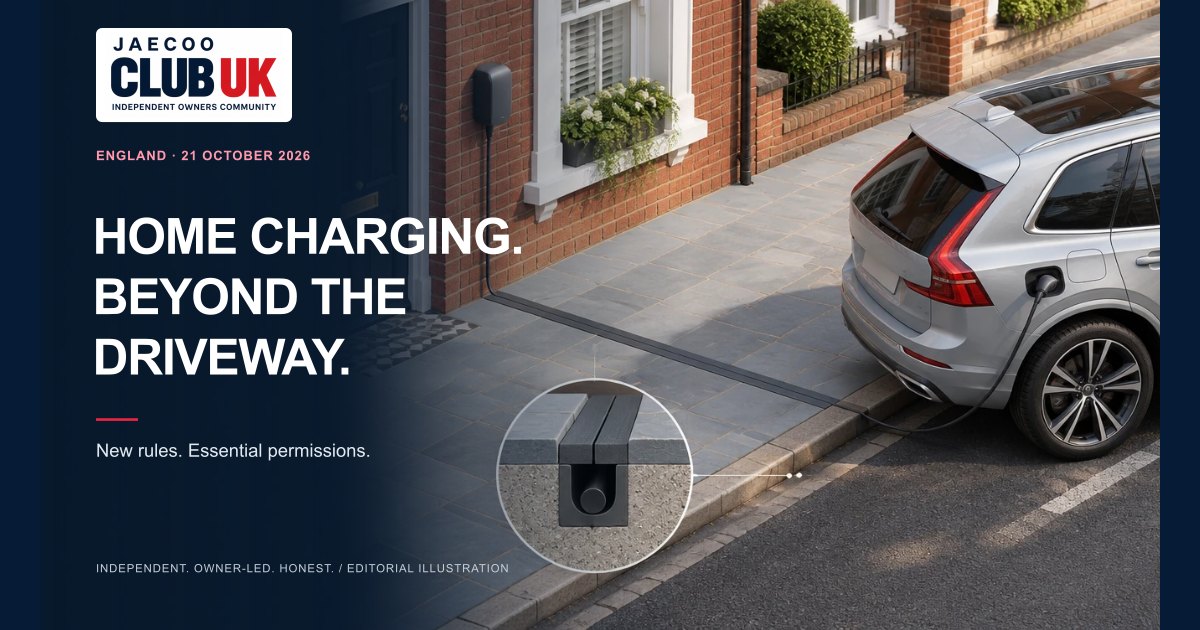
The cover uses a genuine J7 photograph, © M 93 / Wikimedia Commons, under CC BY-SA 3.0 (DE). It is cropped and shaded, with original Club typography and logo. The photographic cover adaptation is shared under the same licence. The vehicle is model-family context, not an exact UK derivative or a photograph of the Budget announcement.
Research sources and methodology
Checked 28 Oct 2026. Official Budget, tax overview, rates annex, current HMRC own-vehicle guidance and the original electricity VAT order reviewed on 28 October 2026. Direct primary-page reads succeeded where some web-tool opens failed. We distinguish current guidance, announcements and intended legislation; no complete audit of every Budget measure or individual tax outcome is claimed. Examples and checklists are Club editorial advice, not measured vehicle results or guaranteed savings.
- HM Treasury: full Budget 2026 — Published and reviewed 28 October 2026. Fuel, charging, territorial scope and future implementation context; announcements distinguished from current law.
- HMRC: Budget tax overview — Published and reviewed 28 October. Sections 1.76, 1.82, 2.7, 2.18 and 2.20 checked for rates, dates and legislative status.
- HMRC: rates and allowances annex — Published and reviewed 28 October; future rates are dated, not applied to every current vehicle.
- HMRC: own-vehicle work expenses — Current guidance read 28 October. Eligible journeys, own versus company car and existing 2026–27 rates; no individual claim assessed.
- Domestic electricity VAT Order 2026 — Made 7 September; original XML re-read 28 October. Current period ends 31 March 2027; the announced extension requires later legislation.
- JAECOO UK: E5 model photograph — Existing source-attributed official exterior photo retained as model context; no Budget-event or charging installation represented.
SOURCES & DISCLOSURE
Go to the original.
HM Treasury / HMRC — read the source ↗Independent editorial roundup by JAECOO Club UK. Source checked 28 Oct 2026. Reported claims and review opinions remain attributed to their original source.