The story
England’s amended permitted development rights took effect on 21 October 2026, providing a route for qualifying domestic chargers and authorised pavement-embedded cable channels. This removes the need for a separate planning application where the relevant conditions are met; it does not give every household permission to lay a cable over a pavement.
The club view
Start with your highway authority and the proposed location. The useful question is whether an authorised installation is available at your address and what the complete cost will be.
21 October update: the planning changes are now in force
The Department for Transport confirmed commencement in its 21 October announcement. The useful change for an owner without a driveway is the qualifying planning route, subject to the legislation’s conditions. Highway-authority authorisation and any relevant property permissions still matter.
The government describes potential savings of up to £300 from removing the planning step. That is an attributed potential saving, not a cash grant or the total price of installing a charger and channel. Ask for a complete written quote for your address before comparing costs.
What changed on 21 October 2026?
S.I. 2026/1056 amends England’s General Permitted Development Order. It was made on 25 September and laid on 30 September. Articles 4 and 5 expand the domestic settings covered by wall-mounted outlets and charging upstands; article 7 adds Class F for cross-pavement channels.
Qualifying installations can use these rights without a separate planning application, subject to the applicable conditions and restrictions. Although the instrument’s legal extent is England and Wales, it amends the England planning regime. Do not apply this guide as a statement of Welsh, Scottish or Northern Irish rules.
Highway-authority authorisation still matters
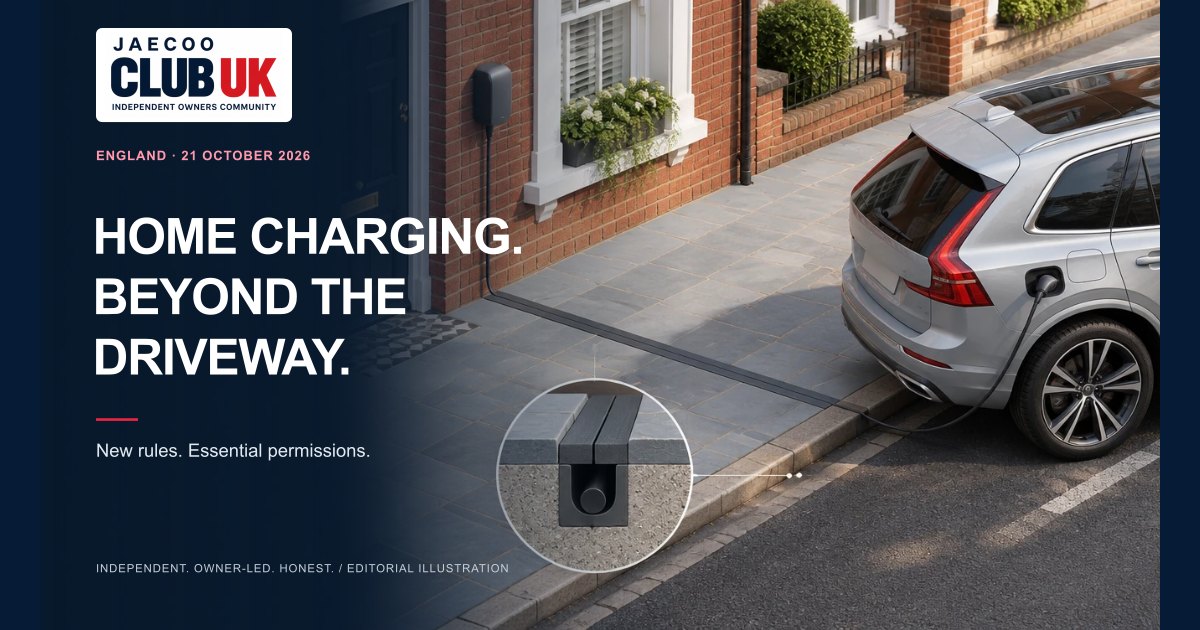
The new route requires a channel installed by, on behalf of, or with authorisation from the relevant highway authority. The definition is a pavement-embedded cable channel carrying a cable from domestic premises to a parked vehicle. A loose lead or a surface cable mat is not that defined solution.
Where a footway separates the charger and vehicle, the new conditions require the cable to cross using an authorised solution when charging. Contact the authority responsible for your road before booking work or buying equipment. A product advertised as compliant does not establish permission for your address.
Important limits to ask about
Class F excludes conservation areas, scheduled-monument sites and listed-building curtilages. It requires removal and pavement reinstatement as soon as reasonably practicable when the channel is no longer needed.
For the new wall-outlet route outside an off-street parking area, there is a one-outlet limit within the dwellinghouse or block’s curtilage, and conservation areas are excluded. The amended wall-outlet rules also set a 1.6-metre installation-height limit. Where the building wall immediately adjoins the highway, the outlet must project no more than 0.2 metres and leave at least 1.5 metres of footway to the carriageway edge.
These are selected limits, not an exhaustive site-design checklist. Existing conditions, property restrictions and other consents can still matter. Ask the planning and highway authorities to confirm the route for the proposed location; flats and shared land also require the relevant property permissions.
A practical sequence for an owner without a driveway
- Check whether your highway authority operates or accepts an authorised channel scheme at your address.
- Confirm the permitted-development conditions and any other planning or property consent needed.
- Obtain a written installation quote including the charger, electrical work, channel, highway fees, maintenance and eventual reinstatement.
- Ask how the cable is managed during use and how the pavement remains accessible.
- Consider whether you can realistically park close enough, within normal parking restrictions. A channel does not reserve the space outside your home.
The North Northamptonshire trial illustrates the role of an approved council scheme; it is not a nationwide application route.
What this means for JAECOO owners
The relevant owners are those charging an E5 battery-electric car or a plug-in J7/J8. A petrol model or non-plug-in hybrid does not gain plug-in charging capability from a planning change. Confirm your exact powertrain in the model guides.
Compare installation and ongoing costs against the public charging you would otherwise use. Base the calculation on your actual tariffs, mileage and access to parking. The new rules do not promise a grant, a particular electricity price or guaranteed savings. Our charging-cost guide helps organise that comparison.
Separate consultations: proposed changes for renters and buildings
Two England consultations were launched on 21 October, with responses invited by 16 December 2026. These proposals are separate from the cross-pavement planning change already in force.
The tenant and leaseholder consultation considers guidance and possible legislation for landlord or freeholder decisions about installing charging at off-street parking spaces. It does not give renters automatic installation approval today or a new entitlement to run a cable across the pavement.
The building-regulations consultation considers changes including charging provision in covered car parks at new buildings and major renovations. It is a proposal, not a new requirement already applying to every existing car park. Follow the original consultation pages if you want to respond.
Research sources and methodology
Checked 21 Oct 2026. Official legislation XML and the Department for Transport’s commencement announcement were reviewed on 21 October 2026. The tenant/leaseholder consultation text and building-regulations consultation description were also read; proposals are distinguished from the planning change in force. The conceptual illustration explains the principle only and is not installation evidence. The original 17 October Club publication date and 30 September legislation source date are retained.
- UK legislation — Made 25 September and laid 30 September 2026; commencement 21 October. Official XML re-read on 21 October; original source publication date retained.
- North Northamptonshire Council: local trial and planning change — Local example; checked 15 October.
- Department for Transport: commencement announcement — Published and read 21 October 2026. Potential planning-related savings attributed to government; installation costs and permissions remain site-specific.
- DfT / MHCLG: tenant and leaseholder consultation — Published 21 October 2026; consultation text read that day. England proposals concerning off-street charging permissions, not enacted automatic approval. Responses by 16 December 2026.
- DfT / MHCLG: building-regulations consultation — Published 21 October 2026; consultation description reviewed that day. Proposed changes kept separate from law in force; detailed technical annex not assessed. Responses by 16 December 2026.
SOURCES & DISCLOSURE
Go to the original.
UK legislation — read the source ↗Independent editorial roundup by JAECOO Club UK. Source checked 21 Oct 2026. Reported claims and review opinions remain attributed to their original source.