The story
Chery’s British ambitions now include a reported proposal for a UK design headquarters, alongside engineering at Millbrook and a non-binding Sunderland manufacturing study. These are distinct projects at different stages. None of the headquarters reporting confirms a JAECOO model for British production or a manufacturing start date.
The club view
The direction is encouraging: engineering and possible manufacturing would deepen the group’s connection with Britain. The test is what gets delivered. We can recognise the potential while being precise that no JAECOO model has been confirmed for Sunderland.
What is confirmed — and what is still a possibility?
Nissan’s 3 June announcement describes a non-binding study. We have not located a later final manufacturing agreement or a named JAECOO allocation in the announcements reviewed. Financial year 2027 remains a possibility in that study, not a promised delivery date.
In its 13 October Paris announcement, Chery set out plans to expand local research, manufacturing and service operations in Europe. These are manufacturer plans; they do not establish which activities will happen in Britain.
Reuters’ 13 October reporting separately describes chairman Yin Tongyue’s interest in local design, engineering, production and supply chains. It is useful evidence of the group’s direction. A European strategy statement cannot, by itself, fill in Sunderland’s model list.
New in this update: Auto Express reports chairman Yin Tongyue’s interest in moving Chery’s design headquarters to Britain. That proposal is distinct from the reported JAECOO brand-headquarters possibility in London. The additional detail is explained below; the original manufacturing sections and publication date are retained.
Nissan and Chery are officially studying Sunderland production
On 3 June 2026, Nissan and Chery International UK announced that they had signed a non-binding MoU to investigate contract manufacturing at Nissan’s Sunderland plant.
Nissan says the Sunderland facility would remain fully Nissan-owned and its workforce would remain employed by Nissan. The proposal includes the possibility of producing Chery International UK passenger vehicles on Production Line One from FY2027.
The background matters.
Nissan had already announced that it planned to consolidate its own manufacturing activity onto Production Line Two while exploring ways to make better use of the rest of the Sunderland operation.
A contract-manufacturing agreement with Chery could therefore give that capacity a new purpose.
For Nissan, that could mean better use of one of Britain’s most important car factories.
For Chery, it could provide access to an established UK manufacturing operation, experienced workers and one of the country’s strongest automotive supply-chain regions.
For Britain, it could mean more vehicle production taking place here rather than simply more imported cars arriving at ports.
That is why this story matters beyond JAECOO ownership.
A separate September development: on 16 September 2026, Nissan announced £170m investment for a Kicks e-POWER model at Sunderland. Read Nissan’s September announcement. That is Nissan’s own model plan, not confirmation of the Chery manufacturing proposal or a JAECOO allocation.
So, are JAECOOs definitely going to be built in Sunderland?
No — not yet.
This is the most important caveat in the entire story.
The Nissan-Chery MoU is explicitly non-binding, discussions are ongoing, and neither company has announced which models would be produced if the project goes ahead.
So it would be premature to say:
“JAECOO 7s will be built in Sunderland.”
What we can say is:
**Future UK-built vehicles from the Chery group are being seriously explored — and JAECOO is one of Chery’s major UK brands.**
If a JAECOO model is later selected for Sunderland, that would mark a major shift for a marque that only entered the UK market in 2025.

Chery is also investing in British engineering
The Sunderland discussion is not Chery’s only UK move.
In August 2026, Reuters reported that Chery planned to establish a UK research and development centre at the UTAC Millbrook proving ground in Bedfordshire.
Reuters said the centre was expected to open in late autumn 2026. Autocar’s 15 October iCaur report describes a Millbrook engineering base as opened. We have not secured a separate Chery or UTAC opening notice, so we distinguish that reported status from the August announcement’s planned timetable. Read Autocar’s report. Its initial focus is expected to include:
- chassis development
- driver-assistance systems
- calibration for UK customers
Longer-term work could expand into autonomous-driving and artificial-intelligence technologies.
That is especially interesting for British owners.
One of the biggest criticisms levelled at newer Chinese cars has never really been about whether the hardware is sophisticated enough. It is often about how that hardware is tuned for European and British conditions.
Suspension feel, steering calibration, lane-assistance behaviour and driver-monitoring systems can all feel very different on UK roads from how they behave in their home market.
A British engineering presence gives Chery the opportunity to develop cars here, on British roads, around British driving conditions.
That is a much more meaningful form of commitment than simply opening more showrooms.
Why this matters for the “cheap Chinese car” stereotype
There is still a perception among some buyers that Chinese brands compete primarily by making cheaper copies of established European, Japanese or Korean cars.
That view increasingly misses what is happening.
Chery is not a small startup.
Chery Group says that on 25 July 2026 it passed 20 million cumulative vehicle sales worldwide, with millions of customers outside China.
The company also says it operates multiple global R&D centres and production bases, while pursuing a localisation strategy built around engineering, manufacturing, supply chains and local employees in overseas markets.
In Britain specifically, JAECOO and OMODA have moved from virtually unknown brands to mainstream new-car sellers in a remarkably short period.
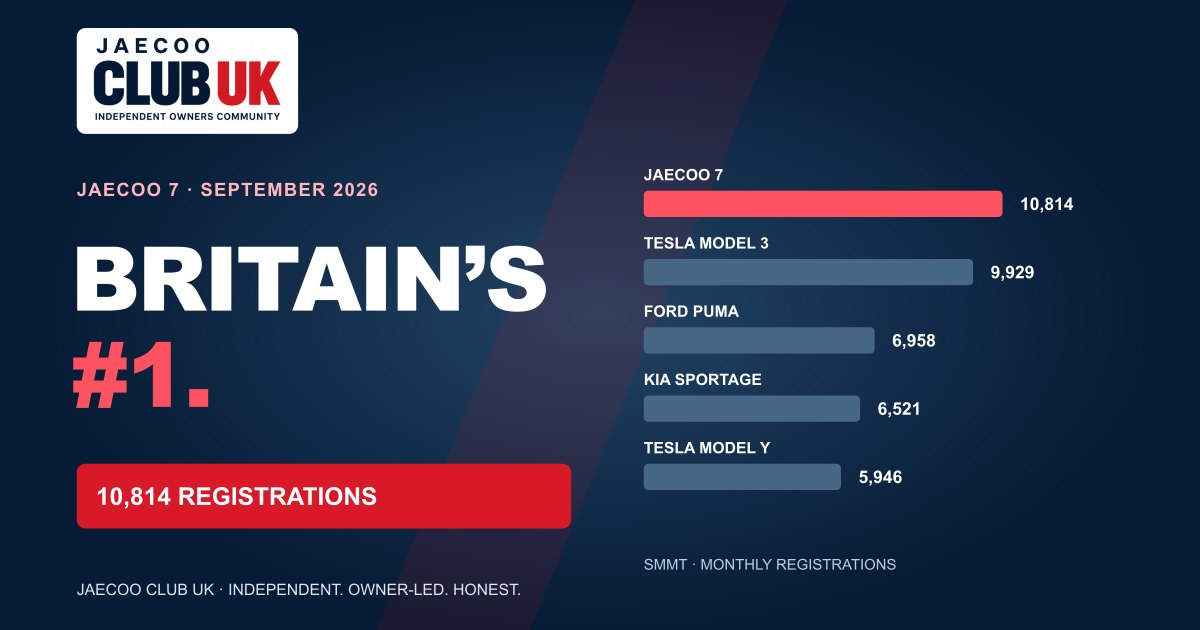
JAECOO 7 has already become one of the UK’s strongest-selling individual models.
That does not mean buyers should stop asking hard questions.
Reliability, parts availability, residual values, dealer quality and long-term software support still have to be proven over years rather than months.
But there is a significant difference between a company that simply exports cheap cars into Britain and one that starts talking about:
- UK production
- UK engineering
- local calibration
- British manufacturing capacity
- long-term R&D
The latter looks much more like a global manufacturer building a permanent presence.
Britain needs automotive investment
The wider UK automotive industry is enormously important to the economy.
According to the Society of Motor Manufacturers and Traders, automotive-related manufacturing contributes roughly £85 billion in turnover and around £18 billion in value added to the UK economy.
SMMT’s Motor Industry Facts 2026 page reports more than 183,000 people employed in manufacturing and some 830,000 across the wider automotive industry. These are sector-wide figures, not a forecast of jobs created by the Nissan–Chery proposal.
The UK also has more than 2,500 automotive component providers, alongside engineering, logistics, finance, steel, chemical, software and aftermarket businesses that depend on the sector.
That means vehicle production creates economic activity far beyond the factory gate.
A busy Sunderland plant does not only matter to Nissan employees.
It matters to suppliers, hauliers, engineering contractors, maintenance businesses, local services and thousands of jobs connected to the wider North East automotive ecosystem.
And this comes at a difficult time for UK vehicle manufacturing
Britain’s car industry is not collapsing, but it is under real pressure.
SMMT figures showed UK vehicle production down 7.5% in the first half of 2026, although later data suggested output was beginning to stabilise and August recorded growth.
The sector is also dealing with major changes in powertrain technology, high energy costs, uncertain export demand and heavy investment requirements for electrification.
Recent years have also brought painful employment news.
Vauxhall Luton
Stellantis announced plans in late 2024 to close its Vauxhall van plant in Luton and consolidate UK light-commercial-vehicle production at Ellesmere Port.
More than 1,100 jobs were put at risk, although the company also committed further investment at Ellesmere Port and planned to offer relocation opportunities to some employees.
Stellantis subsequently reported that activities at Luton ceased in March 2025. The November 2024 announcement is therefore historical context, rather than an uncompleted new closure proposal.
Lotus
Lotus announced in August 2025 that it planned to cut up to 550 UK jobs as it restructured in response to difficult global market conditions.
Those examples should not be simplified into “foreign companies abandoning Britain”. Both situations involved much more complicated business decisions, and investment continued elsewhere.
But they do demonstrate something important:
Automotive manufacturing jobs cannot be taken for granted.
Against that background, an overseas manufacturer investigating ways to bring additional vehicle production into Britain is genuinely noteworthy.
This is not about pretending Chery is coming to “save” British manufacturing
It would be easy to overstate the story.
Chery has not promised thousands of new UK jobs.
It has not announced a new British factory.
And because the proposed arrangement would use Nissan’s existing Sunderland operation and workforce, the immediate effect may be more about protecting factory utilisation and supporting the supply chain than creating a completely new workforce.
That still matters.
Factory utilisation matters.
Production volume matters.
Supply-chain orders matter.
And once a major car plant closes, rebuilding that industrial capacity is extraordinarily difficult.
Using existing British manufacturing infrastructure more intensively is therefore potentially valuable even if it does not produce a dramatic headline figure for newly created jobs.
A future JAECOO could be far more “British” than people expect
If the pieces ultimately come together, the future is intriguing.
Imagine a JAECOO where:
- the underlying vehicle platform originates within Chery’s global engineering operation
- UK chassis and ADAS calibration is developed at Millbrook
- British engineers tune the car for British roads
- final vehicle production takes place in Sunderland
- UK suppliers contribute to the manufacturing process
Would calling that car simply a “cheap Chinese import” still make much sense?
Modern car manufacturing is already extremely international.
Toyota is Japanese, yet has manufactured cars in Britain for decades.
Nissan is Japanese, yet Sunderland has produced millions of vehicles and become one of the most important manufacturing sites in North East England.
BMW is German, but MINIs are built in Oxford.
Automotive nationality has never been as simple as the badge on the bonnet.
Chinese manufacturers are now beginning to follow the same global path.
Why local manufacturing could help owners trust the brand
For existing and prospective JAECOO owners, this story is about much more than patriotism.
One of the biggest barriers facing any new car brand is confidence.
Buyers want to know:
- Will this company still be here in five years?
- Will parts be available?
- Will warranty claims be honoured?
- Will software continue to be supported?
- Will dealerships remain open?
- What will the car be worth in three or four years?
No factory agreement can guarantee the answers to those questions.
But physical investment matters.
Operating research centres, engineering teams and actual production facilities represent tangible commitments. A non-binding study is an earlier step, and should not be treated as investment already delivered.
The more infrastructure a manufacturer establishes in a country, the harder it becomes to view that company as a temporary market entrant chasing quick sales.
That could prove particularly important for JAECOO because the brand’s rapid UK growth has happened so quickly that public perception has struggled to catch up.
For existing owners, none of these plans establishes a retrofit, a software-update timetable or an improvement to a current repair case. The useful evidence will be the facilities, models and support outcomes actually delivered. See our software evidence guide and warranty and service records guide.
Better UK development could improve the cars too
The Millbrook R&D announcement may ultimately be just as significant as Sunderland.
UK roads are unusual.
We have broken urban surfaces, narrow rural lanes, uneven motorway repairs, roundabouts, aggressive lane markings, complicated speed-limit transitions and weather that can change in minutes.
A driver-assistance system that works beautifully on a wide, predictable road elsewhere can become irritating on a British B-road.
Likewise, suspension that feels impressive on smooth asphalt may feel overly firm or poorly controlled here.
Local engineering gives Chery a better chance of addressing those issues at source.
If future JAECOOs are tuned in Britain before they reach customers, owners could see practical benefits in:
- ride quality
- steering
- lane assistance
- driver monitoring
- adaptive cruise behaviour
- parking systems
- road-sign recognition
That is the sort of improvement that changes a brand’s reputation more effectively than advertising ever can.
There is a wider global strategy behind this
Chery has increasingly talked about moving beyond simple exports and becoming more integrated with the countries in which it operates.
The group has described a localisation strategy involving local R&D, manufacturing, talent and supply chains.
It has already established operations and manufacturing partnerships in other international markets.
A Sunderland deal would fit that pattern.
In other words, Britain would not simply be receiving Chinese-built cars.
Britain could become part of Chery’s global industrial network.
That is a very different relationship.
Could UK production help with future trade barriers?
Potentially, although this needs treating carefully.
Governments in Europe and elsewhere have become increasingly concerned about the rapid expansion of Chinese-made vehicles.
The European Union already applies additional duties to certain battery-electric vehicles imported from China.
The UK has so far taken a different approach, but debate over Chinese vehicle imports is growing.
Manufacturing locally could reduce some exposure to future trade barriers, depending on the detailed rules of origin, local content and any future UK policy.
But assembling a car in Britain would not automatically make every trade issue disappear.
The important point is simply that local production gives Chery more strategic options.
And it gives Britain a chance to capture some of the economic value created by the growth of Chinese automotive brands rather than seeing every vehicle arrive fully built from overseas.
We explain the current proposals and the difference between import duties and retail prices in our UK Chinese-car tariff analysis. UK assembly, UK origin and tariff treatment are separate questions.
From Chinese challenger to British manufacturer?
We are not there yet.
But consider how quickly the story has developed.
JAECOO entered the UK market in 2025.
Within roughly two years, the brand has:
- built a substantial UK dealer network
- achieved significant sales volumes
- put the JAECOO 7 among Britain’s strongest-selling cars
- expanded its electrified model range
- seen its parent company commit to UK R&D
- become part of discussions around potential Sunderland manufacturing
That is an extraordinary pace of development.
The next stage will determine whether that momentum turns into genuine long-term trust.
Our view at JAECOO Club UK
We are an owners’ community, not JAECOO’s marketing department.
We will continue reporting faults, software problems, dealer issues and anything else owners need to know.
But independence also means acknowledging positive developments when they happen.
And this is a positive development.
At a time when UK vehicle manufacturing is under pressure, Chery is exploring whether it can bring additional production here.
At the same time, it is investing in British vehicle development at Millbrook.
That does not make every JAECOO perfect.
It does not guarantee Sunderland production will happen.
And it certainly does not mean we should stop scrutinising the brand.
But it does challenge the idea that JAECOO is simply selling cheap imported cars and has no long-term stake in Britain.
The best way to build confidence in a new brand is not through slogans.
It is through investment, engineering, support and commitment.
If Chery and Nissan turn their Sunderland discussions into a full manufacturing agreement — and if JAECOO ultimately becomes one of the brands produced there — it would be a genuinely significant milestone.
For now, the correct word is still could, rather than will.
But the direction is encouraging.
And perhaps the next time somebody dismisses a JAECOO as “just a cheap Chinese car”, owners may eventually be able to answer:
“Actually, this one was built in Sunderland.” That remains a possible future answer, not a claim owners can make today.
UK JAECOO manufacturing: quick answers
Are JAECOO cars currently made in the UK?
No UK-built JAECOO model has been confirmed in the announcements reviewed. The Sunderland agreement is a non-binding study concerning Chery International UK vehicles.
Is the proposed start date 2027?
Nissan’s June announcement refers to the possibility of production on Line One in financial year 2027. This is not a confirmed start date or a named JAECOO model allocation.
Where is Chery’s planned UK research centre?
At UTAC Millbrook in Bedfordshire. August reporting gave a late-autumn timetable; Autocar describes a base as opened in its 15 October report. We have not independently confirmed the operational opening with Chery or UTAC.
Would local assembly automatically remove import tariffs?
No. Manufacturing origin, local content and the final trade rules would need to be examined. Local production could provide options but is not a blanket tariff exemption.
Follow the related trade-policy story
Our Chinese-car tariffs explainer now covers the 9 October EU–China hybrid understanding. It remains separate from the Sunderland study: neither establishes a confirmed UK JAECOO production model or a tariff exemption.
What should an owner watch for next?
The next useful manufacturing announcement should identify the agreement’s status, the actual vehicles, the production location and the timetable. For engineering, look for the site’s confirmed opening and specific work completed for UK cars. An announcement of a centre is not evidence that a particular owner’s lane-assistance system has already been improved.
If you are buying now, assess the car and support available now: a test drive, a written specification, workshop access and the warranty terms. Possible future local production is encouraging context, rather than a reason to overlook today’s ownership questions.
Chery is also expanding its brand portfolio. Our iCaur V27 UK launch report explains the separate sibling brand; it does not establish that iCaur or JAECOO will be built at Sunderland.
Chery’s proposed UK design headquarters: what changes?
Tom Jervis’s Auto Express roundtable interview reports that Chery chairman Yin Tongyue is considering moving the Chery Design Center headquarters to Britain and is speaking to British designers. The page displays 26 October 2026; its metadata records first publication on 23 October and an update on 26 October.
This is a reported ambition, not a confirmed relocation. The reporting reviewed does not establish a selected facility, signed relocation agreement, named design appointments or completion date. We have not verified a formal company announcement settling those points.
The chairman’s interest in British design sits alongside the group’s engineering and manufacturing ambitions. It does not establish that current JAECOO models will be redesigned here, nor that any particular future model will use a British design team.
For readers following the wider story, there are now four different questions: where JAECOO’s brand decisions might be made; where Chery’s design leadership could be based; what engineering is carried out at Millbrook; and whether Sunderland gains a binding manufacturing programme. Evidence for one does not answer the others.
The London brand-headquarters report concerns JAECOO and remarks by Zhang Guibing. The design-headquarters proposal concerns Chery and remarks by Yin Tongyue. Neither should be presented as a completed move by the whole group. Discussion of deeper JLR links in the interview also does not establish an acquisition or merger.
For owners, the useful next milestones are named teams, defined responsibilities, committed facilities and identifiable vehicles. A design proposal alone offers no verified improvement to an existing repair, parts order or software issue. The original Sunderland study remains subject to its own agreement and model-allocation decisions.
Cover photographs and image rights
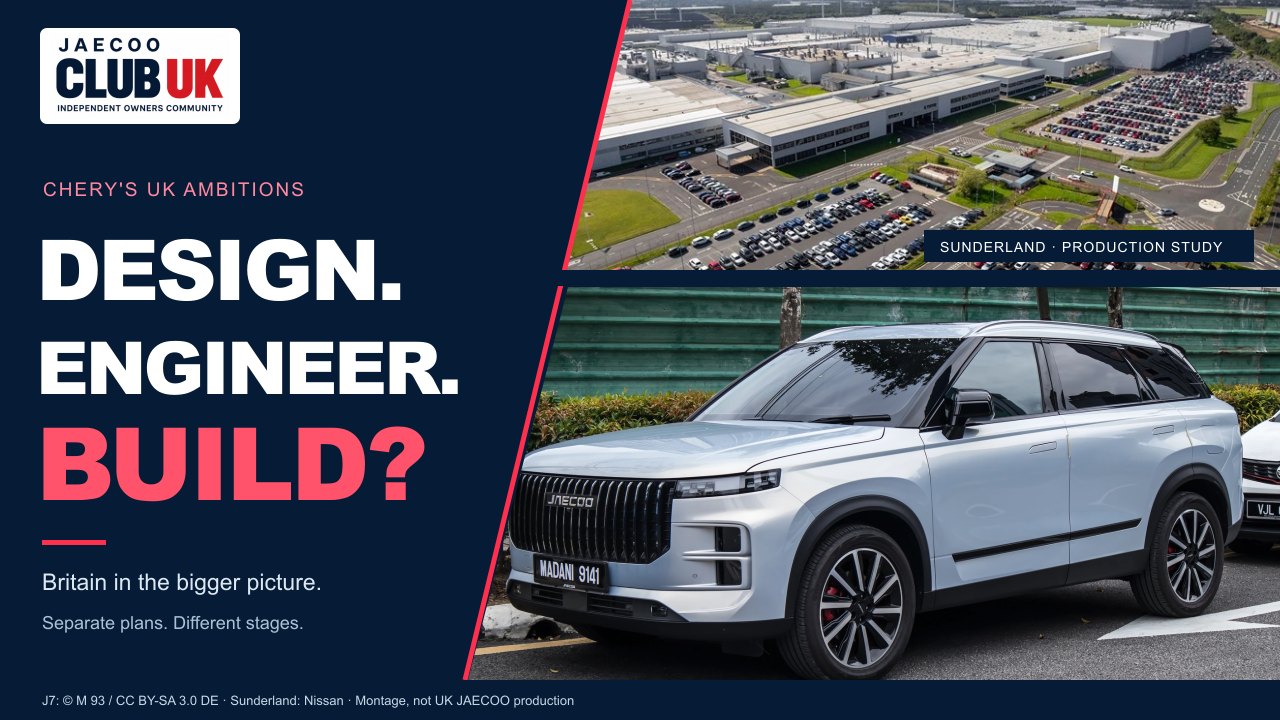
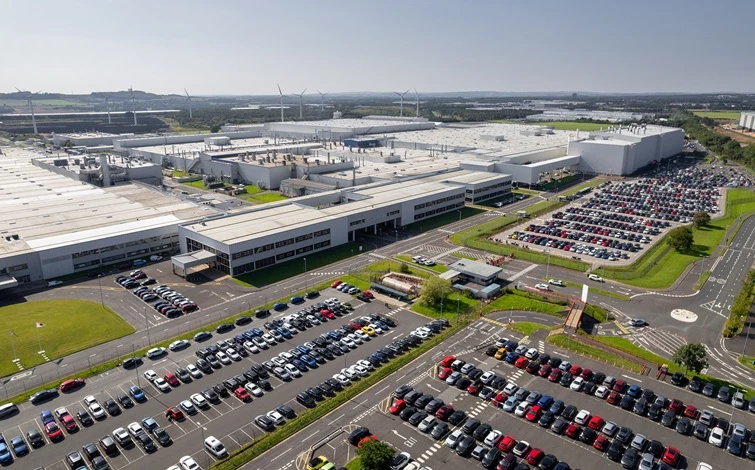
The silver J7 photograph is © M 93 / Wikimedia Commons, licensed CC BY-SA 3.0 (DE). The cropped vehicle-photo adaptation, including its Club typography, is shared under that licence. The separately framed Nissan Sunderland editorial photograph retains Nissan’s image-use terms. The montage brings the subjects together graphically; the photographs depict separate locations. The J7 is model-family context, not evidence of an exact UK trim or British manufacture. No AI-generated factory or vehicle is used in this cover.
Research sources and methodology
Checked 1 Nov 2026. October strategy documents and original reporting were reviewed on 17 October 2026 alongside Nissan’s June non-binding announcement. Older statistics retain their reporting periods. Plans, reported operational status and completed manufacturing agreements are distinguished; no JAECOO model allocation or UK jobs forecast is invented. Substantive update 1 November: original Auto Express chairman interview reviewed for the separate design-headquarters proposal. No completed relocation, chosen site, JLR acquisition or JAECOO production allocation verified. Existing Millbrook opening caveat retained.
- Nissan: Sunderland manufacturing-study MoU — 3 June 2026. Non-binding; Nissan ownership and workforce retained; possible Line One production in FY2027.
- Reuters via Euronext: planned Millbrook R&D centre — 19 August 2026. Planned late-autumn opening, chassis and driver-assistance development.
- SMMT: Motor Industry Facts 2026 — £85bn turnover, £18bn value added, more than 183,000 manufacturing jobs and some 830,000 wider-industry jobs.
- SMMT: first-half 2026 manufacturing context — 31 July 2026 production commentary; historical reporting period kept visible.
- SMMT: August output and EU trade context — 30 September 2026 release.
- Nissan: separate Kicks e-POWER Sunderland investment — 16 September 2026; £170m Nissan model investment, separate from Chery study.
- Chery: cumulative 20-million milestone — Corporate claim: global cumulative sales exceeded 20 million on 25 July 2026; not JAECOO-only sales.
- Sky News: Luton closure announcement — 26 November 2024; more than 1,100 jobs at risk, transfers and Ellesmere Port investment.
- Stellantis: 2025 half-year report — Company report says Luton activities ceased in March 2025.
- ITV News: Lotus restructuring — 28 August 2025; proposed 550 job cuts and stated continuing UK commitment.
- JAECOO UK: September registration announcement — Published 5 October 2026; reported registration performance.
- Nissan newsroom: editorial image-use terms — Sunderland photograph used solely to illustrate independent informational news reporting.
- Chery Group: Paris European strategy — 13 October 2026 manufacturer release; local R&D, production and service plans. Not a UK model allocation.
- Reuters: European localisation plans, via WHBL — 13 October 2026; original reporting by Nick Carey and Rachel More. Chairman’s strategy distinguished from a signed UK production agreement.
- Autocar: iCaur launch and reported Millbrook base — 15 October 2026; opening description attributed to Autocar, not independently established by the club.
- Auto Express: chairman’s UK design-headquarters proposal — Tom Jervis. First-publication metadata 23 October; updated/displayed 26 October 2026. Read 1 November. Ambition, not confirmed relocation or JLR acquisition.
SOURCES & DISCLOSURE
Go to the original.
Nissan / Chery — read the source ↗Independent editorial roundup by JAECOO Club UK. Source checked 1 Nov 2026. Reported claims and review opinions remain attributed to their original source.