The story
MPs have recommended tighter oversight of connected-vehicle data and restrictions on high-risk technology in critical infrastructure. Their report, published on 2 November, is a policy intervention. It does not establish a security incident in a JAECOO owned by a Club member.
The club view
Owners deserve clear answers about the technology in their car. The useful response is to ask precise questions, use supported services and keep any workplace access requirements attached to the relevant site. Neither dismissing every concern nor treating an allegation as a diagnosis helps someone trying to make an informed choice.
What does the report recommend?
The Commons Business, Innovation, Science and Trade Committee wants government and telecoms firms to strengthen oversight of vehicle data traffic. Its initial focus includes government, defence and emergency-service vehicles. It also proposes excluding high-risk connected technology from critical national infrastructure.
Read the original report, particularly paragraphs 96–116. These are committee recommendations to ministers, rather than a new general restriction on private JAECOO ownership.
Has a JAECOO security fault been established?
The material reviewed does not establish that your J5, E5, J7 or J8 has been hacked, remotely disabled or subject to a new security recall. It also cannot supply a blanket assurance that any connected car is immune to attack.
To assess a particular vehicle, we would need evidence tied to its actual systems, software, market and circumstances. A photograph of a camera or a statement about another manufacturer does not complete that investigation. This article reports a public-policy development; the Club has not performed penetration testing on JAECOO vehicles.
Three questions that are worth keeping separate
- What is the concern? A claim about data access, a suspected account problem and a driving-system fault need different evidence.
- Which vehicle and system? Record the exact model, powertrain and relevant module or app. Do not assume every version shares the same feature.
- What has actually changed? A report, a manufacturer advisory, a site rule and legislation each have different practical consequences.
If someone sends you an alarming headline, start with those questions before passing it on as a fact about your car. They are equally useful when the claim is reassuring: “nothing to worry about” needs a basis too.
A practical account and phone checklist
The National Cyber Security Centre’s device guidance recommends keeping supported devices and apps updated, protecting access and using official app sources. That is general cyber-security advice, not certification of a vehicle.
- Use a secure screen lock on the phone you use for car-related services.
- Keep the phone’s supported operating system and legitimate apps updated through their official routes.
- Review the permissions and privacy information for the actual app you use. Ask the provider if a setting or purpose is unclear.
- Keep account credentials private and treat unsolicited “support” messages asking for codes or payment with caution.
- If a service offers additional account protection, follow its official instructions rather than a third-party workaround.
These steps are an account-hygiene checklist. We have not verified that every JAECOO app provides the same login protections or controls.
Vehicle software needs the correct route
A phone-app update is not the same thing as a vehicle-control software campaign. Our software evidence guide explains why the model, module and approval route matter.
Ask an authorised service centre which updates apply to your VIN and how they should be installed. Record the version and the advice you receive. A higher number from another owner’s screenshot does not establish compatibility with your car.
A policy headline is not a reason to pull fuses, unplug modules or install an unofficial download. If a function worries you, ask the manufacturer to explain its intended operation and supported controls. We are not supplying an unverified method for disabling vehicle equipment.
What if I drive to a sensitive workplace?
Ask the organisation that controls the site for its current written access policy. Give it the exact vehicle information it requests and keep any answer with your travel arrangements.
A particular workplace’s requirements should be assessed on their own terms. They do not establish a nationwide restriction, and a national news report does not tell you what a security desk has authorised. If a rule changes, confirm its date, affected vehicles and alternative parking arrangements with the responsible organisation.
Questions to ask before buying a connected car
Bring a short list to the retailer rather than asking only whether a car is “safe”. Useful questions include:
- Which connected services are fitted and active on the exact version?
- Where can I read the privacy information for vehicle services and any separate app?
- What user controls are available, and what changes if I choose not to use an optional service?
- How do I obtain approved software support and report a suspected security issue?
- What is the supported process for removing my accounts and personal information when I sell or return the car?
Ask for documentation or a demonstration. Record unresolved answers alongside the specification and order terms. Our handover checklist and controls guide help turn a general discussion into questions about the vehicle in front of you.
If something unusual happens
Describe what happened, when, which account or function was involved and any message displayed. Keep evidence privately and contact the appropriate official support route. An unexplained symptom is a reason to investigate; it is not, by itself, proof of a cyber attack.
If there is an immediate driving-safety problem, prioritise getting to a safe position and obtaining appropriate assistance. Do not investigate phone or infotainment settings while driving, or post account codes and identifying documents into a public discussion.
What comes next?
A useful follow-up would identify a government response, an actual rule with defined scope, or properly evidenced manufacturer information. Until then, owners can improve their account habits and ask for clearer documentation without pretending a committee report answers every technical question.
The same report has a separate trade-policy strand. We cover that in the Chinese-car tariff explainer, keeping political recommendations separate from a confirmed purchase price. This security article makes no recommendation to sell a car or replace it with a different badge.
Research sources and methodology
Checked 4 Nov 2026. Original committee text and general NCSC guidance reviewed 4 November 2026. Recommendations, technical allegations and enacted requirements remain distinct. No Club vehicle security test, verified JAECOO breach, current universal software version or model-wide diagnosis is claimed. Practical questions are original Club analysis, not verified descriptions of every app or trim.
- Commons committee: China and the UK economy — Published 2 November 2026; original official web text reviewed 4 November, especially paragraphs 96–116. Direct HTTP access was blocked; web-reader access succeeded.
- NCSC: protecting devices — General guidance reviewed 4 November. Applied to phone/app hygiene; not a JAECOO-specific security assessment.
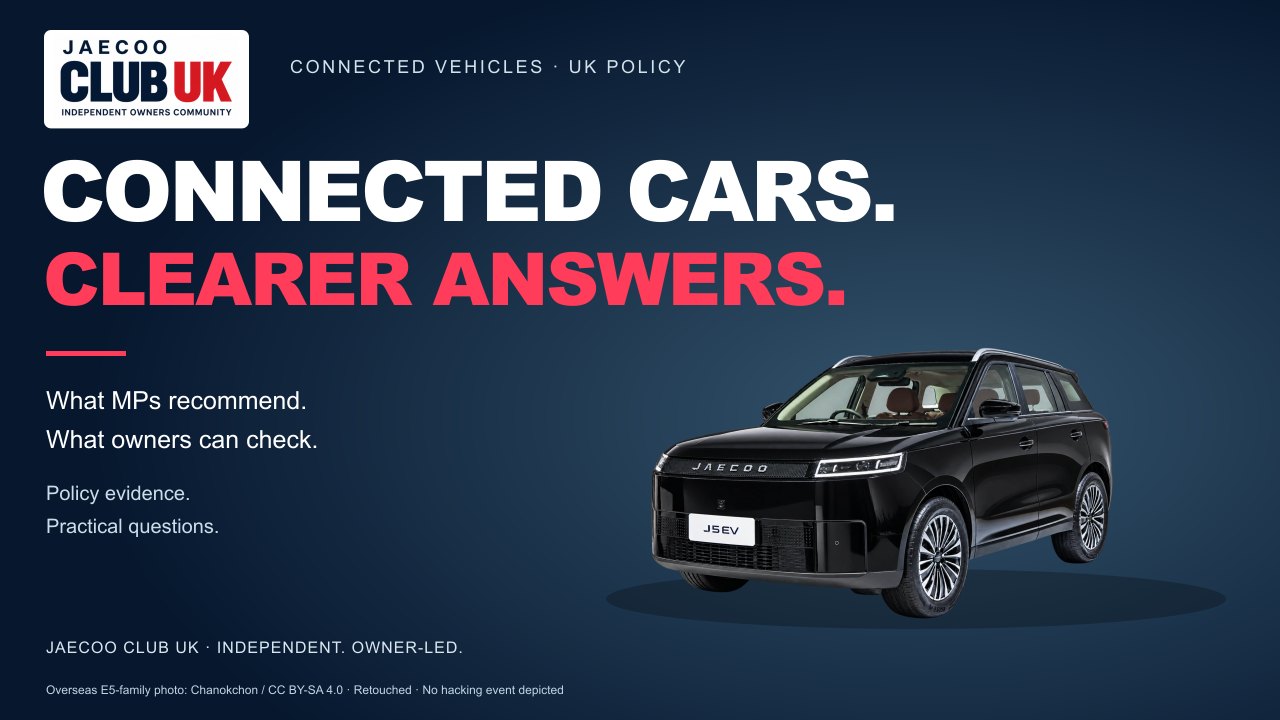
- Cover photograph: Chanokchon, Wikimedia Commons — Real overseas J5 EV Ultra photo. Existing CC BY-SA 4.0 source and constrained editing provenance retained; no fabricated hacking scene.
- Photograph and cover adaptation: CC BY-SA 4.0 — Attribution and share-alike apply; trademark rights unaffected.
SOURCES & DISCLOSURE
Go to the original.
House of Commons committee / NCSC — read the source ↗Independent editorial roundup by JAECOO Club UK. Source checked 4 Nov 2026. Reported claims and review opinions remain attributed to their original source.