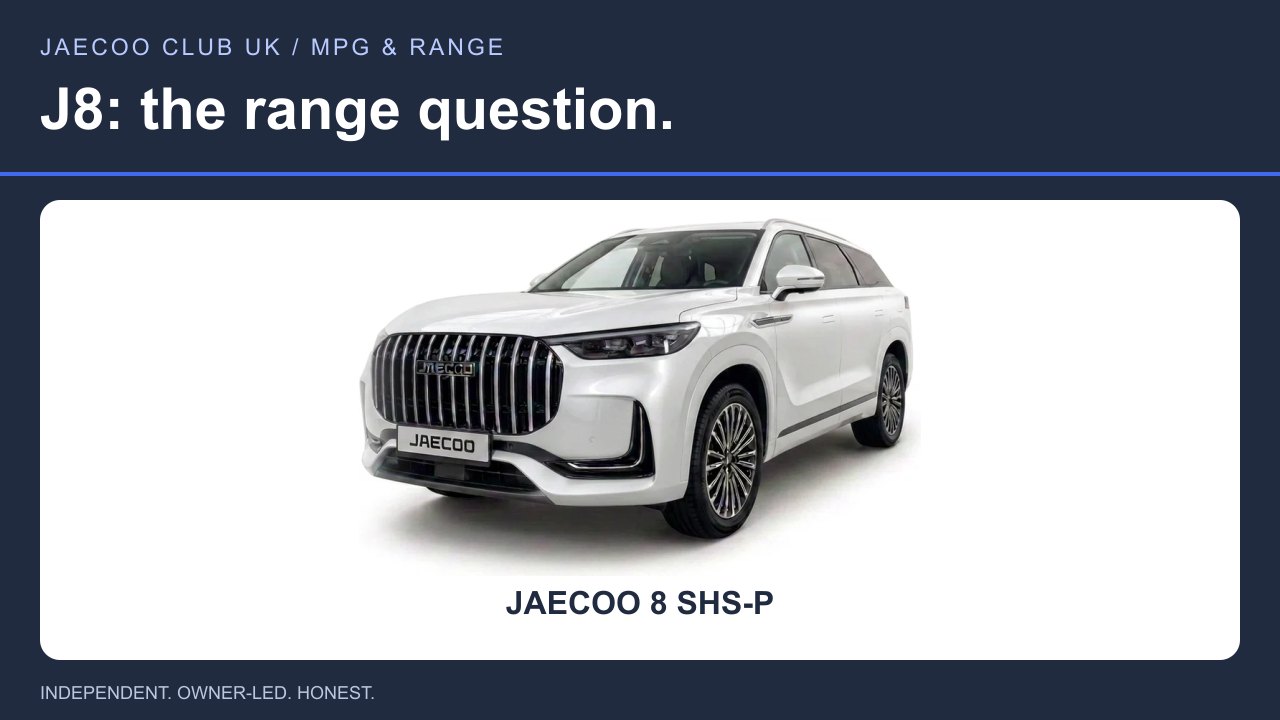
JAECOO 8 SHS-P
A towing maximum is the start of a calculation, not the end of a conversation. Check the exact car, the loaded caravan and the whole outfit before the holiday is booked.
Current UK published limits
| Powertrain / trim | Published braked trailer maximum |
|---|---|
| SHS-P Luxury / Executive | 1,600 kg |
Current official UK table; vehicle plate, handbook, towbar limits, axle loads and gross train weight all still apply. Official unbraked trailer maximum: 750 kg. A trailer maximum does not establish a safe caravan match.
Source: JAECOO UK JAECOO 8 specifications, checked 2026-10-03. Current UK range; confirm the exact vehicle.
Older reviews, overseas specifications and similar-looking models are not evidence for your individual car. Ask the retailer to show the relevant handbook and plate figures for the version you are buying. If a source conflicts with the vehicle documents, resolve the discrepancy before towing.
Two real caravan examples, used as a first screen
Swift’s 2026 range announcement lists the two-berth Basecamp at 1,043 kg MTPLM. Its September 2026 fixed-bed guide lists the Sprite Alpine 4 at 1,247 kg MTPLM. MTPLM is the caravan’s maximum permitted laden mass, not its empty weight. Different model years and approved weight upgrades can change these figures.
Both example figures are below the J8’s current published braked maximum. That clears only the first numerical screen; it does not establish noseweight, train weight, payload, stability or licence compliance.
Read the actual caravan plate and include the battery, mover, gas, water, luggage and accessories in its loading plan. “It was fine behind the previous car” is not a measurement. The examples are comparisons of published limits, not recommendations of safe matched outfits.
The checks a towing headline leaves out
- Car gross vehicle weight: passengers, luggage, accessories and imposed towball load must fit the car’s limits.
- Axle limits: a total below the vehicle limit can still overload one axle.
- Gross train weight: the combined loaded car and trailer must stay within the plated limit.
- Towbar and noseweight: use the applicable vehicle, approved towbar and trailer limits; do not substitute trailer towing capacity for vertical load.
- Trailer approval and brakes: verify the caravan’s own permissible mass and equipment.
GOV.UK explains the manufacturer and train-weight requirements. Where weights are close or uncertain, obtain professional outfit advice and suitable weighing rather than relying on a subtraction in a comment thread.
Licence, equipment and fitting
Check entitlement for your licence and where it was issued. Great Britain and Northern Ireland have separate guidance, so a blanket “UK licence allows it” answer is not enough. Review the official links below for your circumstances.
Ask for a vehicle-approved towbar installation, the correct electrics and any required vehicle configuration. Check mirrors, lighting, breakaway arrangements and the caravan’s instructions. Book a demonstration if you are unfamiliar with connecting the outfit. A parking camera is helpful; it does not replace checking that the coupling and safety equipment are correctly secured.
What towing does to the ownership plan
A trailer changes weight, aerodynamic drag and how you use the drivetrain. Budget with a conservative energy scenario; do not apply the solo WLTP electric range to a caravan holiday. Record your own route, load and energy use before expecting a repeatable figure.
For a plug-in journey, check whether charging bays can accommodate the outfit or whether a safe, permitted uncoupling area exists. Plan stops around the actual site layout rather than the presence of a charging icon on a map. Fuel availability and rest breaks still matter when the car can use petrol.
Before the first trip
- Photograph your own vehicle and caravan plates for private reference.
- Confirm the towbar approval, vertical-load limit and installation documentation.
- Load and weigh the outfit where needed, checking axle and train limits.
- Check tyres and pressures for the load using the correct handbooks.
- Practise connecting, reversing and the safety checks somewhere suitable.
- Keep a dated record of actual towing use and any warnings.
Share a measured ownership update after the trip. Include caravan model year, loading basis and conditions, but keep registration numbers and VINs private.
Make the next answer better.
Got a dated ownership experience, a repair outcome or measured fuel and charging figures? Send it privately for editorial review. Submissions are not automatically published or counted as verified facts.
Public club discussions are not open yet. for the community launch.
SOURCES & REVIEW
Check the original information.
- Current J8 official technical table ↗
- GOV.UK towing weight limits ↗
- Great Britain towing rules ↗
- Northern Ireland licence guidance ↗
- Swift 2026 Basecamp announcement ↗
- Swift Alpine 4 published example ↗
Prepared by JAECOO Club UK. Source information checked on 3 October 2026. Club checklists and examples are editorial suggestions; follow the handbook and terms that apply to your own vehicle. We are independent of OMODA & JAECOO.