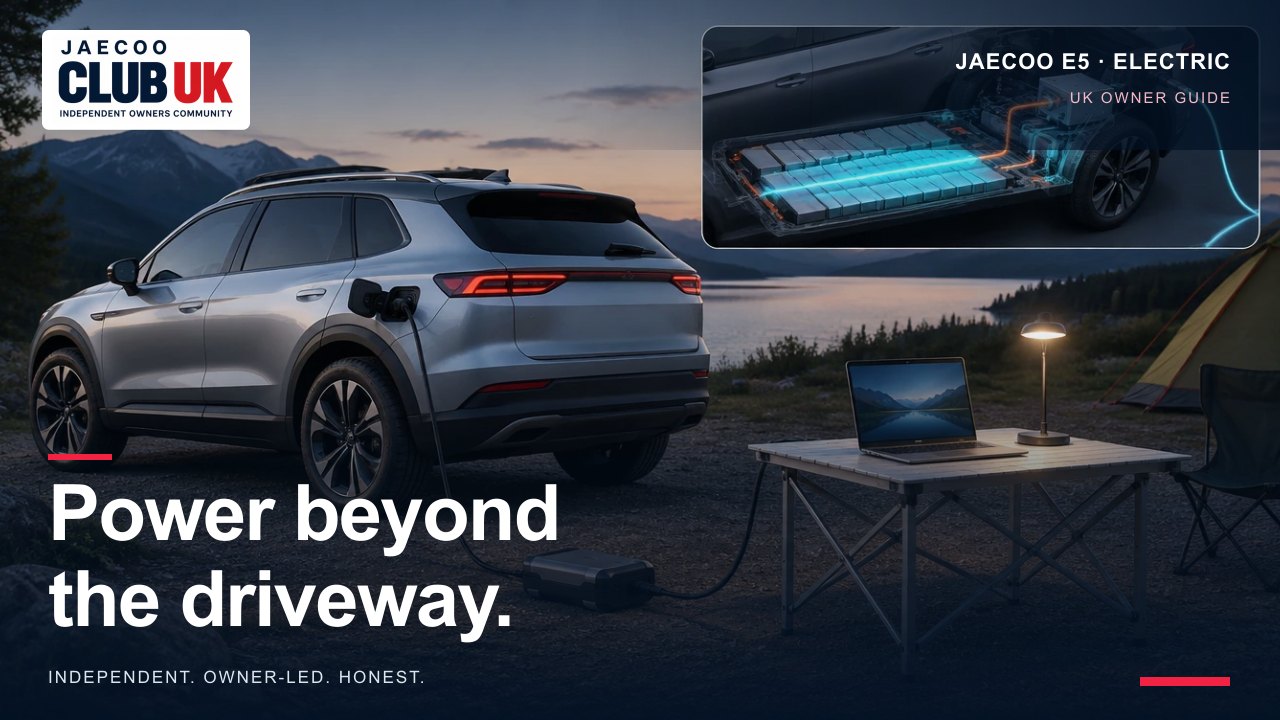
The E5 handbook calls V2L “external discharging” and marks it if equipped. It specifies a separately purchased discharge device and a 3.3 kW vehicle maximum. It also explicitly prohibits a third-party discharge connector that is not the manufacturer’s brand.
Supported models and trims
JAECOO E5 electric: Pure / Luxury, only where the described equipment is fitted
UK manual review; not a hands-on vehicle test. A missing menu may reflect equipment or software; this guide does not promise a feature can be enabled.
Before you begin
Park safely before changing settings. Match the powertrain, equipment and screen layout to the handbook for your own car. A manual describes possible equipment; it is not confirmation that every UK trim has it.
Step-by-step instructions
- Park in a safe location, select P and apply the parking brake. Check that the traction battery has enough charge for the appliances and your onward journey. Inspect all discharge equipment and the dry AC port.
- With the vehicle in READY, open New Energy and turn External Discharge (also called Discharge in the procedure) ON. Keep the vehicle disarmed/unlocked for connection.
- Press the rear part of the charge-port cover to open it. Remove the AC-port and adaptor protective covers.
- Insert the compatible manufacturer discharge connector into the AC port until it seats securely with the described click.
- Press the power strip’s switch. The manual describes a steady blue light on the discharge device when connected and discharge information on the car. This is the adaptor light, not a universal colour rule for every lamp on the vehicle.
- Connect/use compatible appliances within the lowest equipment rating. Watch the car’s discharge information and remaining battery.
- To finish, disconnect the appliances. Put the car in READY and turn Discharge OFF on New Energy, then release and unplug the connector normally.
- Refit protective covers, close the charge-port cover and store the device dry. Confirm it is disconnected before driving.
How much can it power?
The supplied manual states a vehicle discharge ceiling of 3.3 kW. Your usable limit is the lowest applicable rating of the vehicle, adaptor, individual outlet, cable and appliance connection. The vehicle figure is not a promise that a single UK socket can deliver it. Add the loads of every connected appliance and account for starting surges. Use the ratings on your actual equipment; this guide does not promise that a particular kettle, heater or tool is suitable.
No petrol backup
Unlike J7 and J8 plug-in hybrids, E5 cannot start a petrol engine to replenish the battery. Leave sufficient charge for your journey. The cited manual does not give a universal discharge cutoff percentage, so this guide does not invent one.
Troubleshooting
- No output: check equipment compatibility, charge level, the on-screen discharge setting, secure connection and the adaptor’s own switch. DC charging and external discharge cannot be used together.
- Output stops under load: switch off appliances and check their combined running and start-up demands against every applicable rating. Do not repeatedly reset an overloaded adaptor.
- Plug will not release: disconnect the appliances, turn discharge OFF and follow the adaptor’s normal release instructions. Do not pull on the cable or use the charging emergency release as an improvised first step.
- Cooling continues afterwards: the manuals describe automatic fan/compressor operation for battery cooling. A smell, smoke or fault indication is a different matter and needs attention.
Safety and limitations
- Use a correctly specified, manufacturer-approved discharge adaptor and compatible appliances. Inspect the port, plug, cable and power strip first; do not use damaged, corroded, wet or loose equipment.
- Use dry hands in a safe, dry location away from heat, fire, hazardous chemicals and lightning. Keep children away from the equipment.
- Keep appliances out of the boot, away from tyres and away from underneath the front of the car. Protect the cable from crushing, pulling and trip hazards.
- Do not touch electrical contacts, modify connectors, improvise wiring or connect the output to household wiring. These instructions cover standalone appliances.
- Disconnect appliances and switch discharge OFF before removing the adaptor. Never force a locked connector; seek help if the normal release will not operate.
- Stop using the system if you notice unusual heat, smell, smoke or a fault. Do not dismantle equipment; contact the retailer.
Related controls and next steps
SOURCES & REVIEW
Check the original information.
- JAECOO UK JAECOO 5 model page; current UK trim names checked 8 October 2026. Trim naming is not a guarantee of every handbook feature. ↗
- JAECOO E5 UK battery-electric owner manual, issued March 2026; External Discharging Instructions; printed pp. 42, 43, 44, 45, 46 (PDF pages 54, 55, 56, 57, 58). Supplied file: jaecoo ES manual.pdf. ↗
Prepared by JAECOO Club UK. Source information checked on 8 October 2026. Club checklists and examples are editorial suggestions; follow the handbook and terms that apply to your own vehicle. We are independent of OMODA & JAECOO.